Why Is the Ocean So Terrifying to Humans?
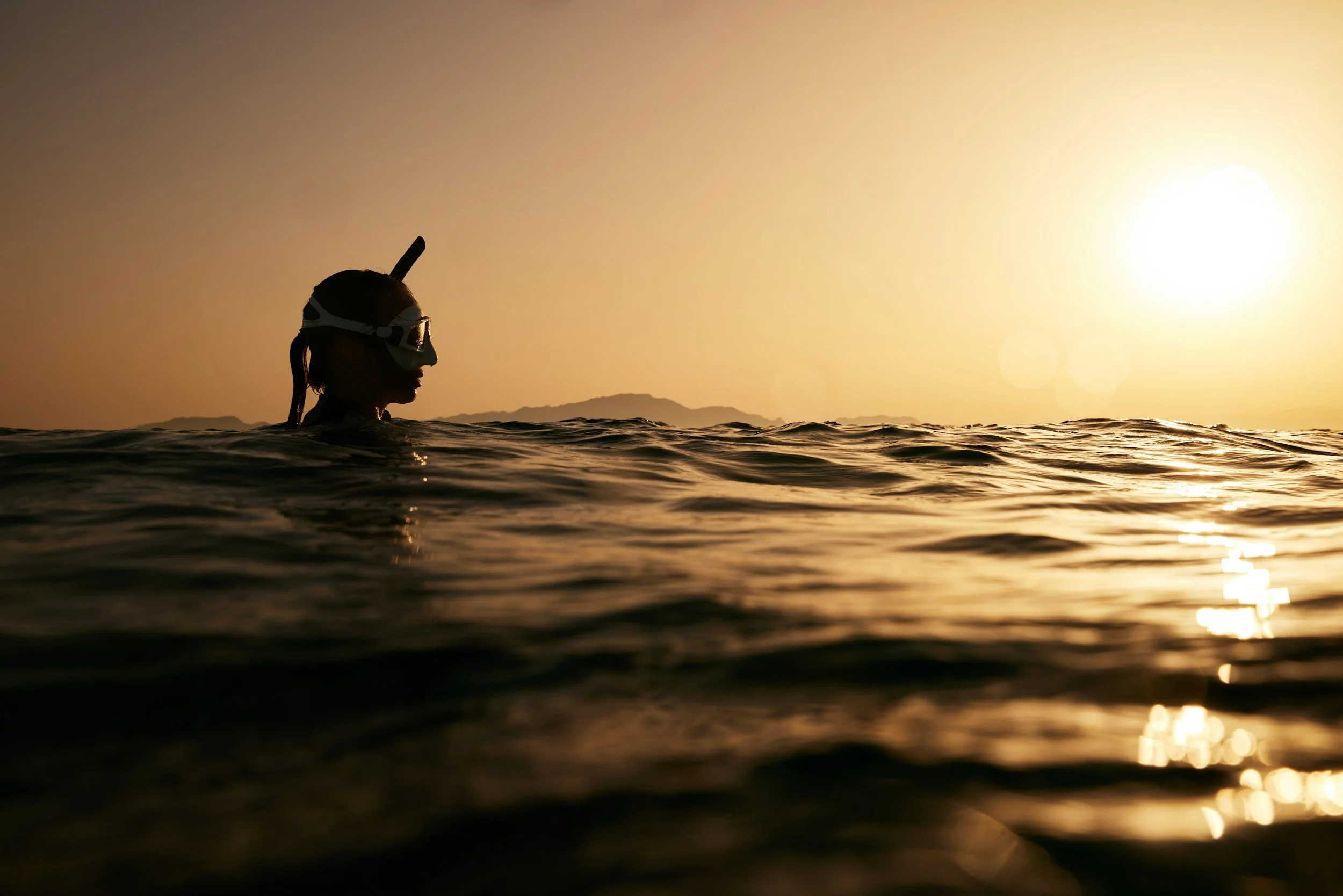
You are floating on the surface of the open sea. You look down, and your eyes cannot find a floor. There are no walls, no trees, and no horizon beneath your feet, just miles of endless blue shifting slowly into pitch black.
Even without a dorsal fin slicing through the water, your heart begins to race. Your chest tightens, and your brain screams at you to get back to shore.
That gut-wrenching feeling has a name: thalassophobia, the deep fear of open or deep water. While horror movies love to blame giant sharks or mythical sea monsters for our ocean anxiety, the truth is much stranger. The ocean frightens us because human biology was never built to survive it. The water itself is the ultimate antagonist.
Evolutionary Instincts and the Visual Void
When you look down into deep, murky water, your brain encounters what psychologists call the visual void. On land, even in the middle of the city or deep within the woods, your eyes rely on depth cues like shadows, horizon lines, and physical structures to calculate distance and safety. Deep water strips all of those cues away in an instant.
Our early ancestors survived by spotting land predators before those predators spotted them. In murky or pitch-black water, that natural early warning system fails completely. The human brain hates an empty canvas, so when it cannot see what lies beneath, it fills the blank space with worst-case scenarios.
This fear of unseen aquatic predators is an evolutionary survival instinct hardwired into our central nervous system. When visibility drops to zero, your body reacts as if a predator is already closing in, spiking your adrenaline before anything even touches your leg.
Human Physiology Under Pressure
To understand why ocean dread runs so deep, we have to look at what water actually does to the human body. We are terrestrial creatures. Our lungs need oxygen gas, our skin requires thermal regulation, and our bones are calibrated for atmospheric pressure at sea level. The deep ocean attacks all three of those physiological needs simultaneously.
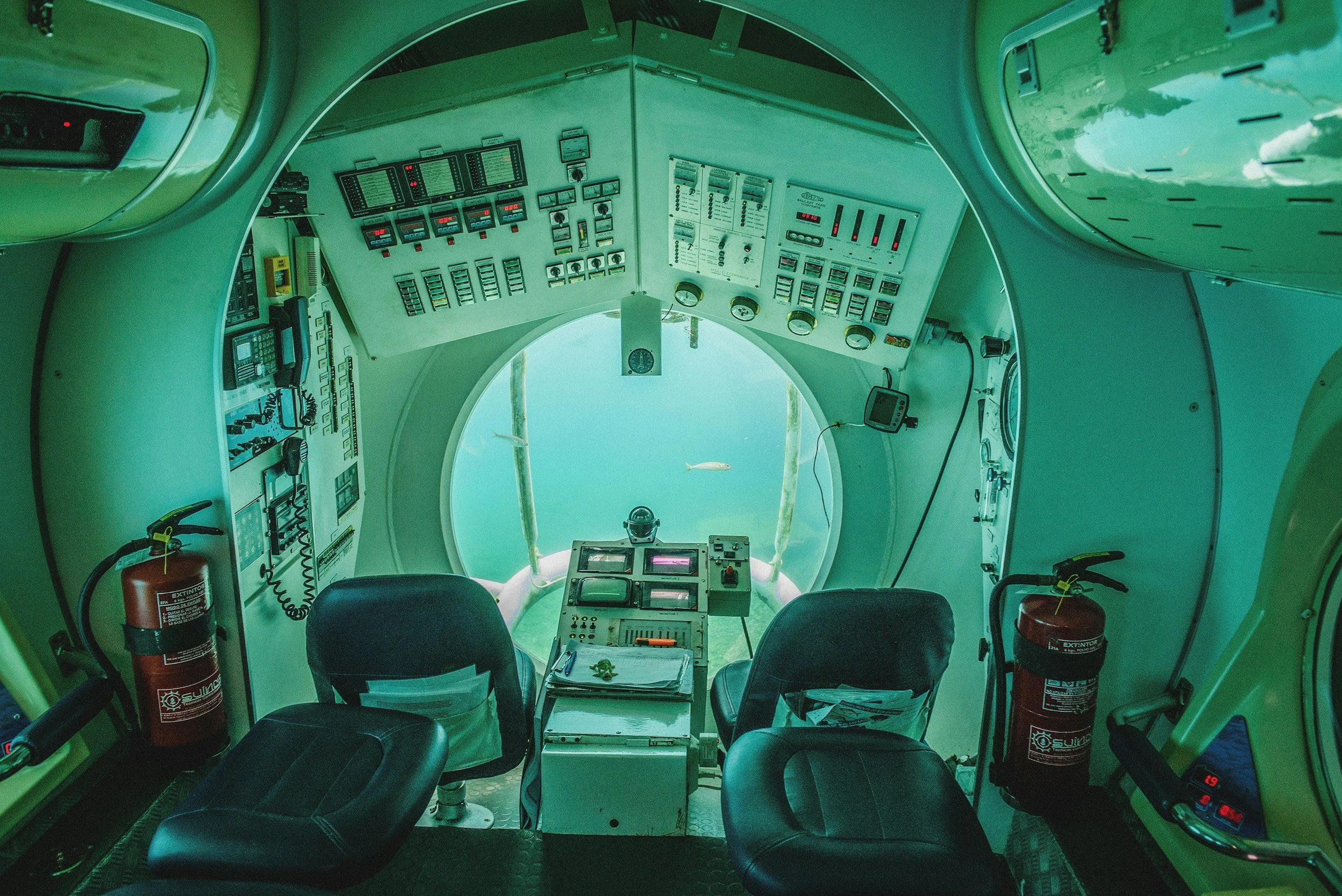
The view from inside a ship meant to handle the intense pressure of the ocean
At sea level, the atmosphere presses down on us at roughly 14.7 pounds per square inch. For every 33 feet you descend into the ocean, hydrostatic pressure increases by another full atmosphere. Unpressurized human bodies or weak submersibles face catastrophic physical failure at extreme depths because water pressure aggressively compresses any air-filled space, including human lungs.
Before pressure even comes into play, cold water immersion presents an immediate physical threat. In cold sea water, hypothermia can incapacitate a swimmer's muscle control within minutes, making swimming impossible regardless of willpower.
If water enters the airway, the body enters drowning mechanics. During wet drowning, water enters the lungs and stops oxygen transfer. In dry drowning, the vocal cords spasm shut to keep water out, sealing the airway and causing suffocation without water ever entering the lungs. The body's physiological response to drowning is pure panic, which is why drowning scenes in horror hit us on a primal level.
For deep-sea divers, gas management creates additional psychological horror. Breathing compressed air at extreme depths causes nitrogen narcosis, often called rapture of the deep. Excess nitrogen dissolves into the bloodstream under high pressure, altering brain chemistry and causing symptoms similar to severe drunkenness, hallucinations, and loss of sanity.
Monsters of the Abyssal Zone
If you want to know where filmmakers get their monster designs, look no further than abyssal zone biology. Below 3,200 feet, the bathypelagic zone receives zero sunlight, forcing creatures to adapt in terrifying ways.
Deep-sea animals frequently display abyssal gigantism, growing to massive proportions compared to their shallow-water relatives. Because food is scarce in the dark, creatures like the anglerfish or the gulper eel evolved unhinged jaws, translucent skin, vestigial eyes, and needle-like teeth that fold backward. These features look unnatural to us because they violate the body shapes we expect from surface animals.
Many deep-sea predators also use bioluminescence for hunting and camouflage. By producing their own light via chemical reactions, they create glowing lures in the pitch-black water, turning the darkness itself into a trap.
The Sea as an Uncaring God
Long before modern marine biology, human cultures personified the ocean as a chaotic, untamed force. Ancient maritime folklore gave us sea monsters like the Leviathan, Tiamat, and the Kraken. Historical sailors used these mythic creatures to rationalize sudden shipwrecks, rogue waves, and the terrifying reality of being lost at sea.
In modern fiction, this evolved into cosmic horror. Writers like H.P. Lovecraft realized that the ocean bed is the perfect sleeping place for ancient, indifferent gods. The sheer scale of the ocean reinforces human insignificance. When a character stands at the edge of the Mariana Trench, they are looking at a location less explored than the surface of the Moon. Ocean trenches function as ultimate symbols for the unknown, reminding us that humanity does not rule the planet.
Blackwater Diving and Submechanophobia
Ocean dread is not just about open space; it is also about confinement. Underwater entrapment during cave diving or blackwater diving creates extreme environmental claustrophobia.
During a "silt-out," a diver's fins kick up fine sediment on a cave floor, dropping visibility to zero in a second. In total darkness, surrounded by solid rock walls, gas management becomes a race against time. The psychological urge to panic and breathe faster drains oxygen supplies rapidly, turning a technical dive into a lethal trap.
For others, horror comes from submechanophobia, the fear of submerged man-made objects. Sunken shipwrecks, drowned ruins, and rusted oil rigs evoke a deep sense of uncanny disturbance. Seeing objects made for land slowly colonized by marine life creates a visual sense of frozen catastrophe, reminding us that the ocean reclaims everything eventually.
The Sound and Dread of Ocean Acoustics
Sound behaves differently underwater than in air. Water is denser than air, allowing sound waves to travel nearly five times faster and cover far greater distances. However, because sound reaches both human ears almost simultaneously underwater, the brain loses its ability to pinpoint direction. Every sound feels like it is happening everywhere at once.
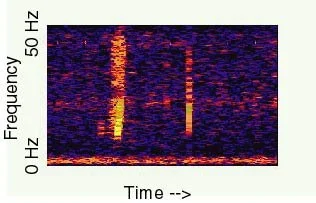
Frequency versus time of the infamous bloop
Sound designers in horror use this quirk of physics to manipulate audience anxiety. By incorporating low-frequency hums and infrasound, sound designers induce physical feelings of dread, nausea, and disorientation without the audience knowing why.
Mysterious acoustic recordings have fed viral horror theories for years. The most famous example is the "Bloop," an ultra-low-frequency sound detected by hydrophones across the Pacific in 1997. While scientists confirmed the sound was an icequake, the idea of an unidentified sound echoing across thousands of miles of deep water captures our fear of what might be listening down below.
Though our human minds still want to believe that it is an unnatural creature or something equally interesting.
Respecting the Abyss
Whether you are watching a underwater creature feature, playing an abyssal horror game, or standing on a dock at night, ocean dread boils down to a simple truth. The ocean is an environment where humans have no control, no natural defense, and no room for error. The water does not need to hate us to destroy us; it only needs to exist.
READ MORE ENVIRONMENT HORROR ENCYCLOPEDIA ENTRIES