Why Is It So Easy to Get Lost in the Woods?
Forests have a way of disorienting people faster than they expect. Even experienced hikers, hunters, and locals who know the land can lose their sense of direction within minutes. Even if you have a clear navigation path, the environment can work against you. A sudden rainstorm or taking the wrong turn while talking can quickly stack up.
Suddenly, everything looks the same. Then you start to doubt yourself, and panic sets in. That’s when things really go wrong! Being lost in the woods is rarely subtle at first, so it is essential to recognize the gradual buildup that often occurs.
The Illusion of Familiarity
One of the most immediate challenges when someone is lost in the forest is visual repetition. Trees, undergrowth, and natural patterns often lack clear landmarks. As mentioned, what seems distinct at first quickly blends into sameness.
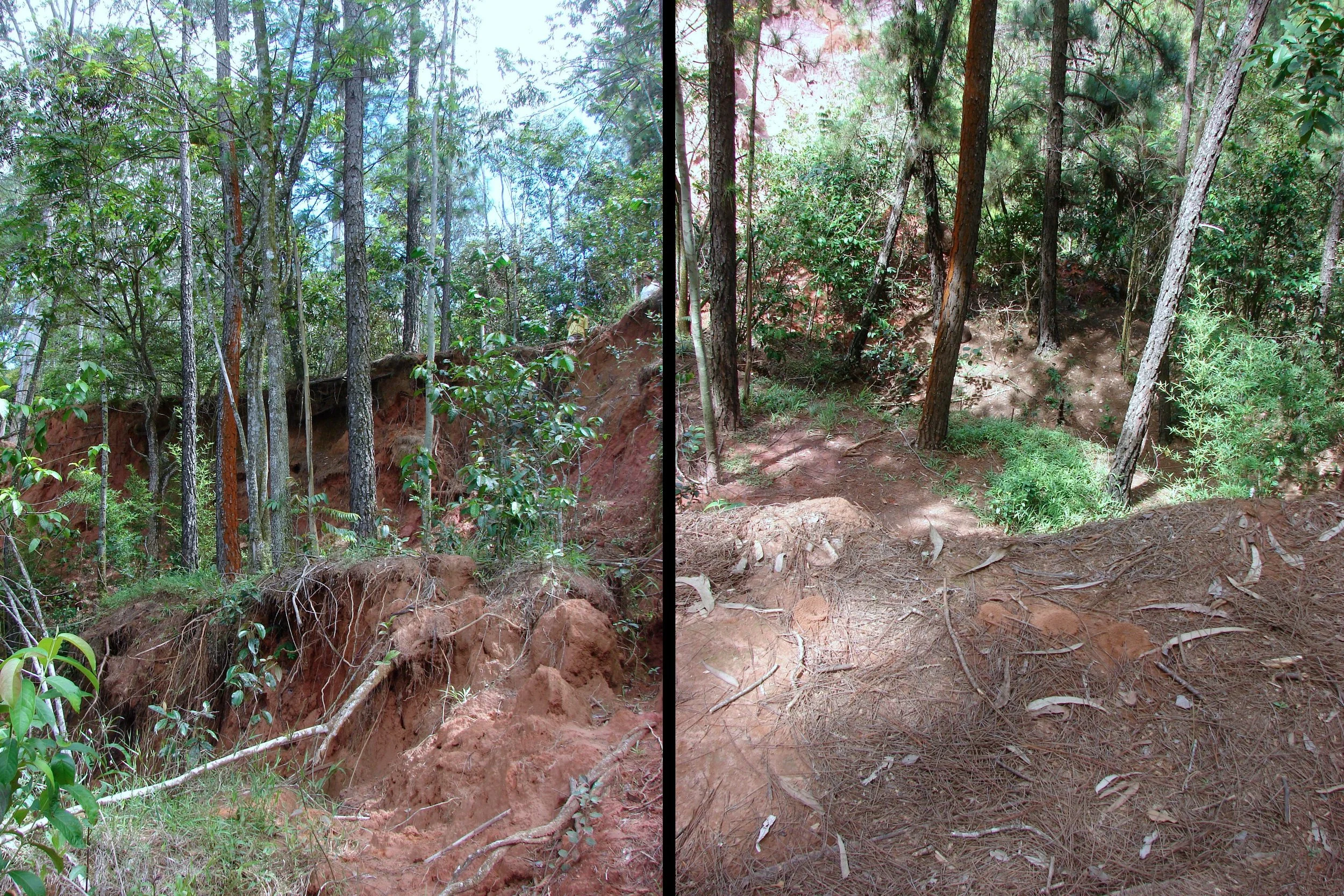
The same patch of forest, but the view is different because of erosion
Humans rely heavily on recognizable markers to orient themselves. In urban environments, this is easy. You can use streets, distinct buildings, and obviously directional and named signs provide constant feedback. In a forest, that feedback disappears. A cluster of trees can look identical to the one you passed ten minutes ago.
Even subtle shifts in terrain can mislead. A slope that feels gradual going up may feel entirely different coming down. From a personal standpoint, I have been on hiking trails where the environment has changed from one visit to the next, such as the case when a storm occurs and erosion happens.
Without a fixed reference point, people often circle back on themselves without realizing it.
How the Brain Misguides Direction
There is a persistent belief that people can walk in a straight line if they try hard enough. In reality, most cannot.
When someone goes missing in the woods, it is common for them to walk in circles. This happens because:
One leg is often slightly stronger than the other (literally because we as humans are rarely symmetrical), creating an unconscious curve.
Visual cues are limited or misleading.
The brain struggles to maintain a fixed direction without external anchors.
Studies have shown that even in relatively open terrain, people drift off course without noticing. In dense forest, where visibility is restricted, this effect becomes more pronounced.
Cloud cover, thick canopy, or fading daylight can remove the sun as a directional guide. At that point, the brain begins to guess. And it is not particularly good at guessing direction under stress.
Sound, Silence, and False Signals
Sound behaves differently in wooded environments. It can carry farther than expected or vanish entirely, depending on terrain and density.
Someone who is lost in the woods may hear distant voices, water, or movement and assume it is closer than it actually is. They may move toward it, only to find nothing. Or worse, move deeper into unfamiliar terrain.
Silence can be just as disorienting. Forests often feel quieter than they are, especially when the wind drops and wildlife goes still. That quiet can amplify internal noise like breathing, footsteps, or the sense that something is just out of sight. As people become aware of their own breathing, they often begin to breathe faster or deeper, which can escalate into hyperventilation and panic.
It is not uncommon for people to misinterpret natural sounds under stress. A branch snapping might feel deliberate. Movement in the brush might seem like it is following.
The Role of Panic and Decision Fatigue
Once a person realizes they are lost in the wilderness, the psychological shift is immediate. Calm decision-making begins to erode.
Panic introduces a few predictable problems:
Faster movement without direction
Poor decision-making
Ignoring basic survival instincts like staying put
Decision fatigue also plays a role. Every choice becomes a question. Which direction? Follow water or stay elevated? Keep moving or stop?
Over time, these decisions compound until you are truly and utterly lost. The brain becomes overwhelmed and defaults to action over logic. That is often when people move farther away from where they were last seen instead of staying put.
Environmental Factors That Increase Risk
Certain forest conditions make disorientation more likely:
Dense canopy reduces visibility and blocks sunlight.
Uneven terrain alters perception of direction.
Seasonal changes like fallen leaves or snow erase trails.
Wildlife paths can resemble human trails but lead nowhere useful.
Even experienced outdoorsmen can be misled by animal trails or dried creek beds.
Why It Feels Different Than Other Places
There is a reason so many lost in woods horror stories resonate. Forests create a specific kind of isolation.
Unlike open landscapes, you cannot see how far you have traveled. Unlike cities, there is no structure to guide you back. The environment closes in rather than opens up.
Moments like this are what give being lost in the wilderness meaning for a horror piece. Thematically, the scene stops being about direction (finding one’s way back) and then becomes a symbol of the loss of control, a separation from the systems that usually keep people safe, and the fear of isolation.
In a forest, there is no immediate correction. No map unless you brought one. No signal unless you are lucky. Just you and the wildness and the hope that the direction you are going in will eventually lead to safety.
A Note for Horror Writers
Getting lost in the woods does not need to rely on anything supernatural to feel unsettling. The fear is already built into the environment.
What makes it effective is restraint. A character who thinks they recognize a tree. A path that should lead somewhere but does not. The slow realization that movement is not helping.
Sometimes the most effective detail is the simplest one. Put yourself in the character’s perspective, consider the fact that you have been walking for an hour, and nothing has changed. Then two hours, then three, and by nightfall, that’s when the real horror begins.
READ MORE ENVIRONMENT HORROR ENCYCLOPEDIA ENTRIES