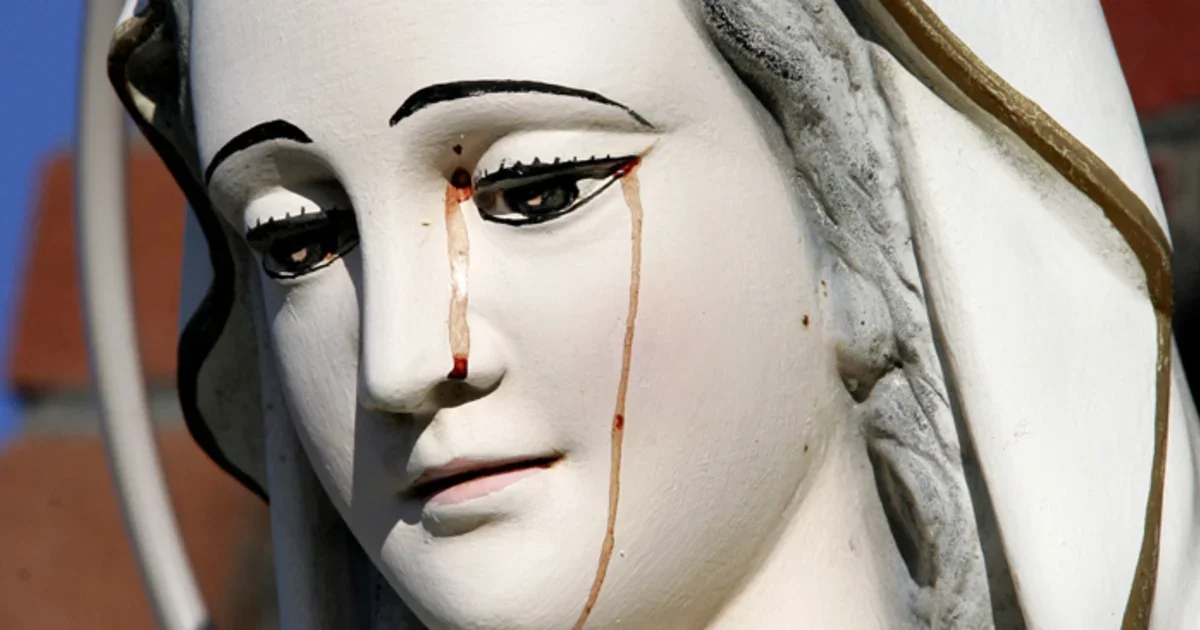
Can Religious Statues Really Cry Blood?
There is a very specific moment when a holy object turns terrifying.
It rarely happens when a statue is broken or chipped. Instead, it happens when cold plaster or carved wood starts doing something only a living body should do’ like sweating, shedding tears, or leaking fresh blood down its painted cheeks.
In the world of religious history and supernatural lore, this phenomenon is called lacrimation (weeping clear tears) or sanguine lacrimation (weeping blood). For centuries, reports of weeping Virgin Marys and bleeding crucifixes have drawn thousands of hopeful pilgrims, triggered intense scientific debates, and fueled some of the scariest scenes in horror movies. Oftentimes, it can be even more terrifying than an unnatural creature.
Before we call an exorcist, or a team of scientists, we need to look closely at the materials themselves. By examining the wood, paint, chemistry, and human psychology behind these events, we can understand why stone appears to cry, how investigators spot a fake, and why the image of a bleeding saint cuts straight to our deepest fears.
A History Carved in Stone and Cedar
Long before modern news cameras captured crowds gathering around glowing church altars, ancient communities reported statues that seemed to come alive.
In ancient Greece and Rome, statues were not treated as simple decorations. Many people believed a statue could physically hold a piece of a god's presence. Roman historians, including Livy, wrote down multiple accounts of statues sweating, weeping, or bleeding during times of war and political disaster. Back then, a bleeding icon was almost never seen as a comforting miracle. It was an omen—a terrifying warning from the heavens that something terrible was about to happen.
By the Middle Ages, the tradition of weeping or bleeding icons became deeply rooted in European Christian tradition. Blood carries enormous symbolic meaning in Christian theology, representing sacrifice, penance, life, and forgiveness.
When a carved wooden crucifix appeared to leak red fluid from its hands or ribs, it brought historical violence directly into the present moment. It closed the distance between a story in a holy book and a frightened worshiper kneeling on a cold stone floor.
The Science of Sweating Statues
Before declaring a miraculous event, forensic investigators and art restorers look at how the physical object was built. Statues are physical things made of materials that react to light, heat, water, and age. In many cases, a "bleeding" icon is actually a very strange chemical reaction.
Porous Materials and Trapped Moisture
Many traditional statues are made of porous materials like wood, terracotta, or soft plaster. Plaster works a lot like a dense kitchen sponge. If a hollow plaster statue sits in a damp basement, a cold crypt, or an unheated chapel, it absorbs water vapor from the air over time.
When the room warms up—say, when hundreds of visitors light candles nearby, that trapped moisture expands and pushes outward through tiny cracks in the paint. If the inside of the statue contains rusting iron supports, old animal glues, or mineral deposits, the liquid that oozes out will not be clear water. It will be a rusty, reddish-brown fluid that looks alarmingly like dried blood.
Microscopic Invaders
Trapped moisture also creates a paradise for microscopic life. A common bacterium called Serratia marcescens is famous for growing in damp places and producing a bright red pigment.
When a bloom of red bacteria grows inside moist cracks around a statue's eyes or painted wounds, normal condensation can wash the red pigment down the face. To someone standing several feet away in a dimly lit room, it looks exactly like fresh tears of blood.
Decomposing Oils and Glazes
Creating sacred art historically involved mixing primers, oil paints, tree resins, and varnishes. Over many decades, these organic coatings break down. Old resins can liquefy when heated, forming sticky, dark amber or reddish droplets. When liquid varnish runs down a painted face, it mimics weeping wounds with disturbing accuracy.
Mechanical Tricks and Devotional Fraud
Not every crying statue is an accident of chemistry. Throughout history, people have used clever tricks to fake bleeding icons, sometimes to make money from tourists, sometimes to boost religious faith during tough times, and sometimes as an outright hoax.
The mechanical tricks used to fake these events have been surprisingly clever:
Hidden Canal Systems: Craftspeople could carve tiny channels through the back or base of a wooden statue, running fine tubes up to the eyes. A bladder or syringe hidden behind a wall or curtain could be squeezed to push liquid out on demand.
Melting Wax Mixtures: Statues were sometimes coated with mixtures of animal fat, oil, and red dye that stayed solid in cold air. When candles were lit nearby during a service, the heat melted the hidden wax mixture, causing red drops to run down the cheeks.
Siphon Strings: Using hidden threads hidden beneath thin layers of paint, a concealed reservoir of liquid in the statue's base could slowly draw fluid upward using capillary action, letting it drop out through small holes near the eyes.
Today, scientists do not rely on visual checks alone. Investigators use chemical analysis, DNA profiling, and light spectrum tests to examine the fluid. Modern tests can quickly tell whether a fluid is real human blood, animal blood, paint, or a mixture of olive oil and rust.
How Miracle Investigations Work
The Catholic Church approaches claims of weeping statues with a high level of official skepticism. Unlike popular horror movies where local priests immediately claim a miracle to draw crowds, official policy requires strict investigations to prevent fraud.
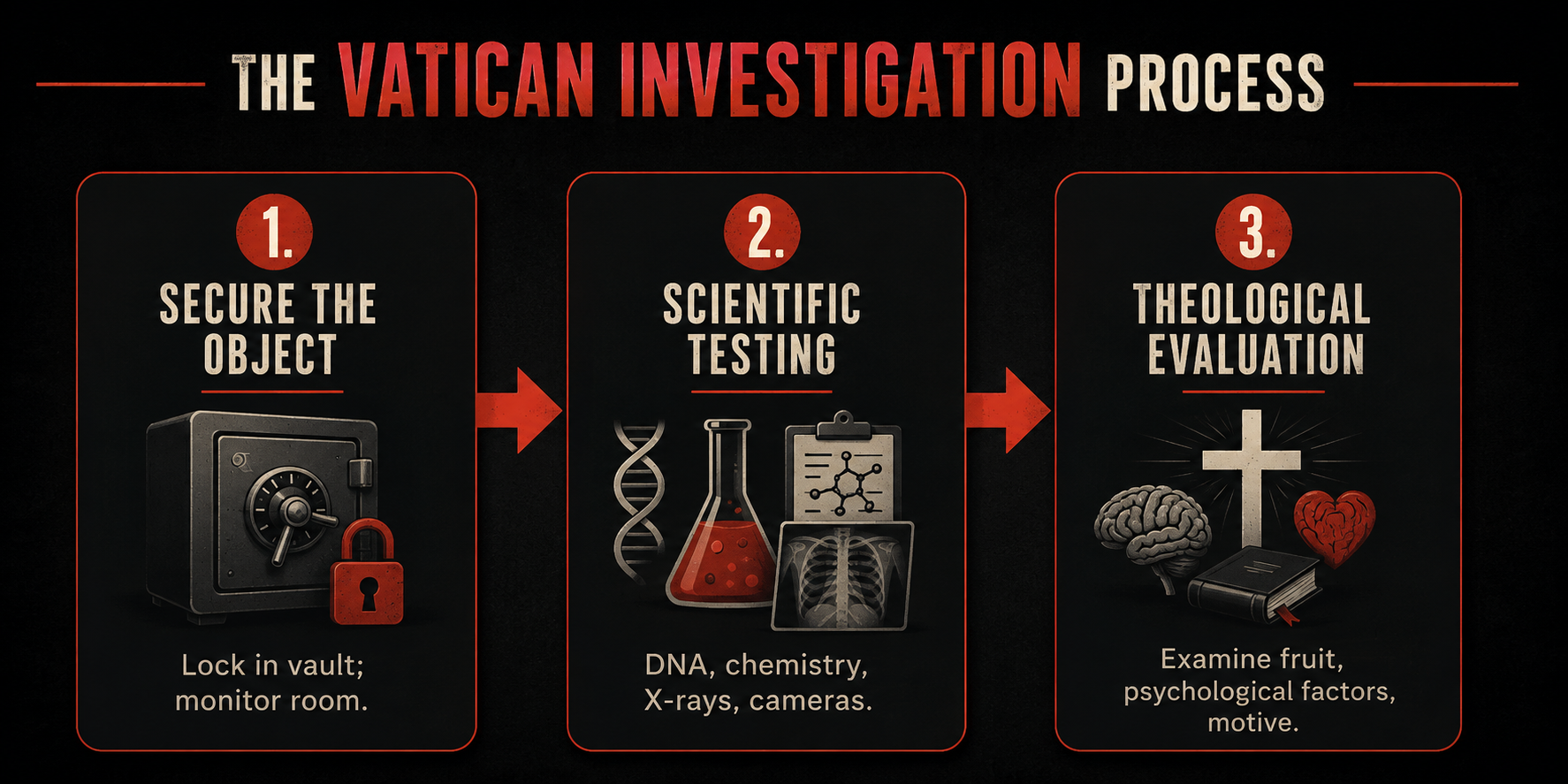
When a statue reportedly bleeds or cries, the local bishop launches a formal inquiry under guidelines established by the Vatican:
Isolation: The statue is taken off public display and locked in a secure room. Temperature and humidity are kept stable, and video cameras monitor the room to make sure no one touches it.
Scientific Testing: Independent medical examiners and chemists test the liquid. If the fluid is human blood, lab technicians run DNA tests. In several past cases, DNA testing proved that the blood on the statue matched the person who claimed to discover the miracle.
Structural X-Rays: Technicians scan the statue with X-ray or CT equipment to ensure there are no hidden pumps, tubes, or hollow cavities concealed inside the wood or plaster.
Community Assessment: Investigators look at the emotional state of the witnesses. Are people selling tickets or souvenirs? Is the event bringing people together peacefully, or is it causing panic and confusion?
Only after every natural, chemical, mechanical, and psychological explanation has been ruled out will church authorities consider classifying an event as unexplained—and official declarations of true miracles remain extremely rare.
Notable Real-World Cases
The history of lacrimating objects includes several famous events that blur the line between unexplained mysteries and intense public debate.
Our Lady of Akita (Japan, 1975–1981)
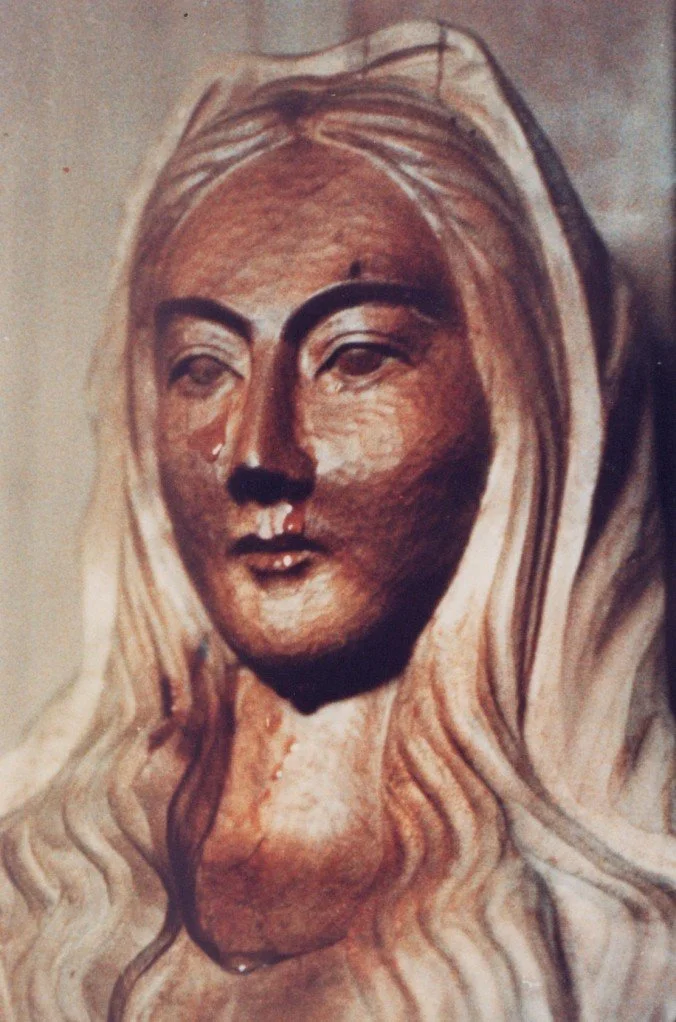
A close-up shot of Our Lady of Akita found in Japan
In 1975, a wooden statue of the Virgin Mary at a convent in Akita, Japan, reportedly began weeping tears and bleeding from a carved wound on its hand. Dozens of witnesses, including the local bishop, reported seeing the liquid over several years.
Samples of the fluid were sent to the forensic department at Akita University. Tests confirmed that the fluid was real human blood, sweat, and tears belonging to blood type O. While scientists and researchers still discuss the findings, Akita remains one of the most famous documented cases of statue lacrimation.
The Civitavecchia Statue (Italy, 1995)
In 1995, a small plaster statue of Mary brought from Croatia to Civitavecchia, Italy, reportedly wept tears of blood fourteen times. Laboratory tests verified that the fluid was male human blood.
The case sparked enormous media attention and a formal church investigation. While the owner of the statue declined to give a DNA sample for direct comparison against the blood on the statue, the event left a permanent mark on local religious culture.
Why Bleeding Statues Terrify Us in Horror
Why does a weeping statue strike such a deep nerve of fear?
The answer lies in a psychological idea called the uncanny valley, the deep discomfort we feel when an artificial object looks or acts almost, but not quite, human. While there are medical diseases that can cause the skin to harden like stone, something about an inanimate object triggers a different type of fear.
A statue is supposed to be still, solid, and silent. It represents a memory, an idea, or a figure preserved in cold stone. When that artificial body starts oozing real fluid, our normal expectations break down completely:
Broken Physical Rules: We trust non-living objects to stay still. When stone behaves like human skin, our basic sense of physical safety vanishes.
Corrupted Protection: In stories involving religious horror, statues of saints represent safety and divine shelter. When a sacred image bleeds, it signals that the shelter has been breached. The protective barrier is gone, leaving people exposed to whatever danger is lurking nearby.
Demonic Mimicry: In supernatural stories, evil entities rarely show their true forms right away. Instead, they copy holy signs to mock believers, cause confusion, or trick people into letting their guard down. A bleeding statue forces characters to ask a scary question: Is this a message of help, or a dangerous trap?
Whether appearing in classic horror movies, Gothic novels, or modern thrillers, the bleeding statue remains horror's ultimate shortcut for a world where the boundary between the living and the dead has completely broken down.
READ MORE OCCULT HORROR ENCYCLOPEDIA ENTRIES